Where Should My Child Study?
I'm writing this post with a clear awareness that it will stir up a lot of opinions. Some people will likely disagree with me, others might be offended. But there isn't a week that goes by without someone asking me: "Where should I enroll my child?"
So I decided to share my perspective - as it is. Not as the universal truth, but as a position I've arrived at after years of thinking, observing, and personal experience.
Important clarification: the following lines are my personal opinion, based on two fundamental values:
- Education - I come from a family of teachers. Knowledge and learning have always been held in high regard in our home.
- Growth mindset - I believe that every person is born with human and intellectual potential, and it is our responsibility - especially as parents - to help unlock and realize that potential.
If you share these values, this post will probably be useful to you.
1. Why Does It Matter Where My Child Studies in First Grade?
Because that is exactly when the first educational habits are formed - and those stay with us for life.
- How you learn.
- Why you learn.
- Your overall attitude toward education.
All of this is shaped in the very early years.
In some schools, the learning process is a duty - for both children and teachers. In others, it's play, curiosity, and enthusiasm.
Statistical Probability
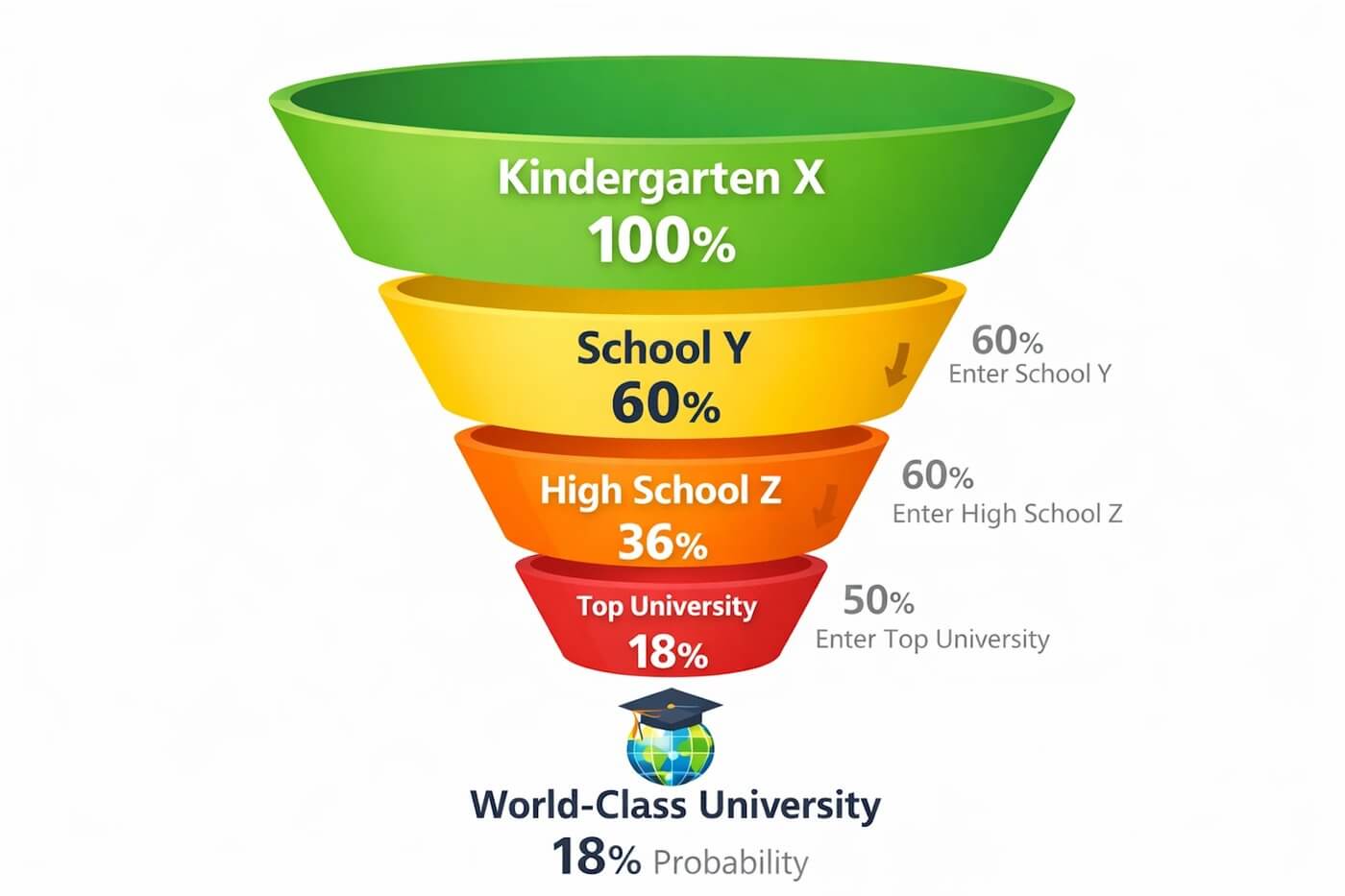
When I was choosing where to enroll my eldest daughter, I discovered this: there is a kindergarten where 60% of its children go on to enter the school with the highest academic results in Bulgaria. Of those, about 60% continue to the American College (elite high school). And roughly 50% of those graduating from the American College go on to top universities in the world.
It turns out that with what may seem like a small decision - which kindergarten to choose - I have already given my child about an 18% chance of eventually studying at one of the best universities in the world. For comparison: the average probability for a Bulgarian student is about 0.05%.
In other words - simply by this choice, I have given my child 360 times the chance of her peers.
Enrolling your child in a good school might be one of the most important decisions in their life. And not enrolling them - is also a decision.
In a large percentage of cases, not choosing well means depriving them of the chance to realize their full potential. Differences between children begin to accumulate early - and grow each year in a way that is often impossible to make up later.
A simple example: if one school teaches 4 hours of math per week, and another teaches 10, how do you expect those children to be at the same academic level after 1, 2, 5, or 10 years?
Not least, there are numerous studies showing correlations between success in adulthood and the presence of certain skills already at ages 6-7. One such skill is delayed gratification, which some schools cultivate intentionally, and others completely ignore.
2. Public or Private School?
There are elite public schools in terms of academic achievements. There are also incredible teachers who do miracles.
But unfortunately - these are the exceptions, not the rule.
The Environment
In the majority of cases, I personally would choose private school, mainly because of the environment - both the students and the parents.
My daughter's classmates discuss: competitions, what book they've read, upcoming tests - instead of the latest pop star hit or last night's reality TV episode.
That is the kind of environment I want for my child.
In private schools, there is an economic filter - and no, not all private schools are full of snobs and wealthy families. In fact, I'd say the opposite: in most private schools, parents are completely ordinary people - driving 10-year-old cars and paying mortgages - but they share a clear value for education.
Teachers and Motivation
In public schools, teachers are often crushed by bureaucracy. Their salary might not change for decades, no matter what they do.
In private schools:
- there is more independence,
- a teacher's salary is tied more to results,
- and a principal has a real incentive to keep good teachers.
In a public school, a principal usually has a guaranteed number of students based on district, regardless of quality. So their biggest concern is avoiding a negative inspection - not improving the school. In such an environment, initiative is punished and enthusiasm is crushed.
So what type of teacher survives there? Often, those without passion - or without alternatives.
And if a teacher goes to school out of obligation - what can we expect from their students?
Facilities
Yes, it sounds superficial, but it matters whether a child enters a bright, clean, modern building - or a gray, crumbling classroom with old desks.
The physical condition of a school becomes a reflection of the attitude toward learning.
Homework and Communication
In many public schools, homework is assigned daily and often becomes a burden rather than a tool. A growing body of research questions the value of this approach.
In private schools, there are often no homework at first, then reasonable weekly assignments. Teachers and parents work as a team, with meaningful communication - not just awkward group parent meetings. It's not perfect, but it's far better.
3. Am I Taking Away My Child's Childhood?
First, what is childhood? It's the opportunity to play, to be mischievous, to explore the world physically, socially, and emotionally - through play, not obligation.
Children in private schools absolutely get all of these experiences - unless a parent forces them into endless extracurricular activities.
Like everything else - it's about balance.
No extreme is sustainable:
- Ten years of unstructured screen time and zero expectations rarely produce independence; they usually produce dependency on comfort and avoidance of effort.
- Ten years of nonstop academic pressure rarely produce fulfillment; they more often produce anxiety, resentment, and emotional burnout.
Also consider that in our information age, children mature much faster than previous generations. If you continue to treat your 7-year-old son as a baby or your 10-year-old daughter as a small child - you're not doing them any favors.
And let's not forget summer - three carefree months every year. So no - you probably are not taking childhood away. You're giving them skills and a stronger start to life.
4. "It's Not Where They Study - It's Who Their Teacher Is"
Both are important.
In most cases, wherever you enroll your child in first grade - they will stay there through seventh grade. That's seven years in which foundational attitudes and skills are built.
Yes, the first teacher is hugely important because they shape the child's relationship with learning. But in some schools, the chance of encountering a truly good teacher might be 20%, while in others it might be 80%.
Do your research and choose wisely.
5. When Should Preparation Begin?
In my personal opinion - around age 2-3.
- Reading fairy tales → stimulates love for reading and builds abstract thinking.
- Learning letters and numbers through play.
Examples from our daily life:
- With my eldest daughter, we turned car rides into games - spotting license plates from outside our city and identifying letters. That's how she learned the alphabet.
- With my younger one, we count by skipping numbers - she says "1", I say "3", she says "5", and so on. Sometimes I make mistakes on purpose so she can correct me and we laugh together. Now we've moved on to math - I give her 2 apples and ask "If you eat one, how many are left?"
The key is:
- be engaged;
- set a personal example - if you constantly scroll your phone, don't expect your kids to read books;
- share topics that genuinely interest you - this teaches curiosity and creates meaningful time together.
Final Thoughts
It's not easy being a parent. We want the best for our children, and choosing where they should study is a major, difficult decision - balancing between giving them a strong start in a competitive world and preserving a carefree childhood.
But the earlier you start thinking about these questions, the greater the chance your child will develop and unlock their full human and intellectual potential.